
Federal Bureau of Prisons Releases
The BOP Locator covers federal inmates from 1982 to the present. It is a national prison source, not a county roster and not a general arrest index. A person prosecuted in federal court may appear even though no BOP institution is located in Braxton County. Conversely, a person held only at CRJCF on an ordinary state or local matter should be checked through WVDCR and the West Virginia courts.
BOP cautions that its custody history can include more than convicted sentenced prisoners. Records can involve pretrial detainees, material witnesses, civil contemnors, or people whose charges were later dismissed. A locator match proves a BOP-related custody record, not the full case outcome. Use the federal docket to identify the charge, disposition, sentence, and supervision judgment.
| System | Custody covered | Release meaning |
|---|---|---|
| BOP Locator | Federal BOP records from 1982 onward | Departure from BOP custody |
| CRJCF/RJA | West Virginia regional-jail custody | Facility event or transfer |
| WVDCR DOC | State prison and active supervision | State custody or supervision status |
| ICE ODLS | Immigration detention and some recent releases | ICE custody event only |
Search BOP Federal Releases
Use the BOP Inmate Locator. The most precise route uses a BOP Register, DCDC, FBI, or INS number. A name search also allows available age, race, and sex filters. Compare identifiers carefully. The result fields include name, register number, age, race, sex, release date, and location.
A past date paired with “Released” or “Not in BOP Custody” and no institution identifies the end of that BOP episode. A future date is projected and can change. “UNKNOWN” means the term has not been determined. First Step Act recalculations and other sentence events can change an expected date, so record the day the locator was checked.
- Choose an identification-number search when a verified number is available.
- Otherwise enter the exact name and use only supported filters.
- Compare the register number and identity fields.
- Read the date together with the location or custody label.
- Check the federal court docket and any next custodian.
The official BOP locator interface is shown in the captured source below.
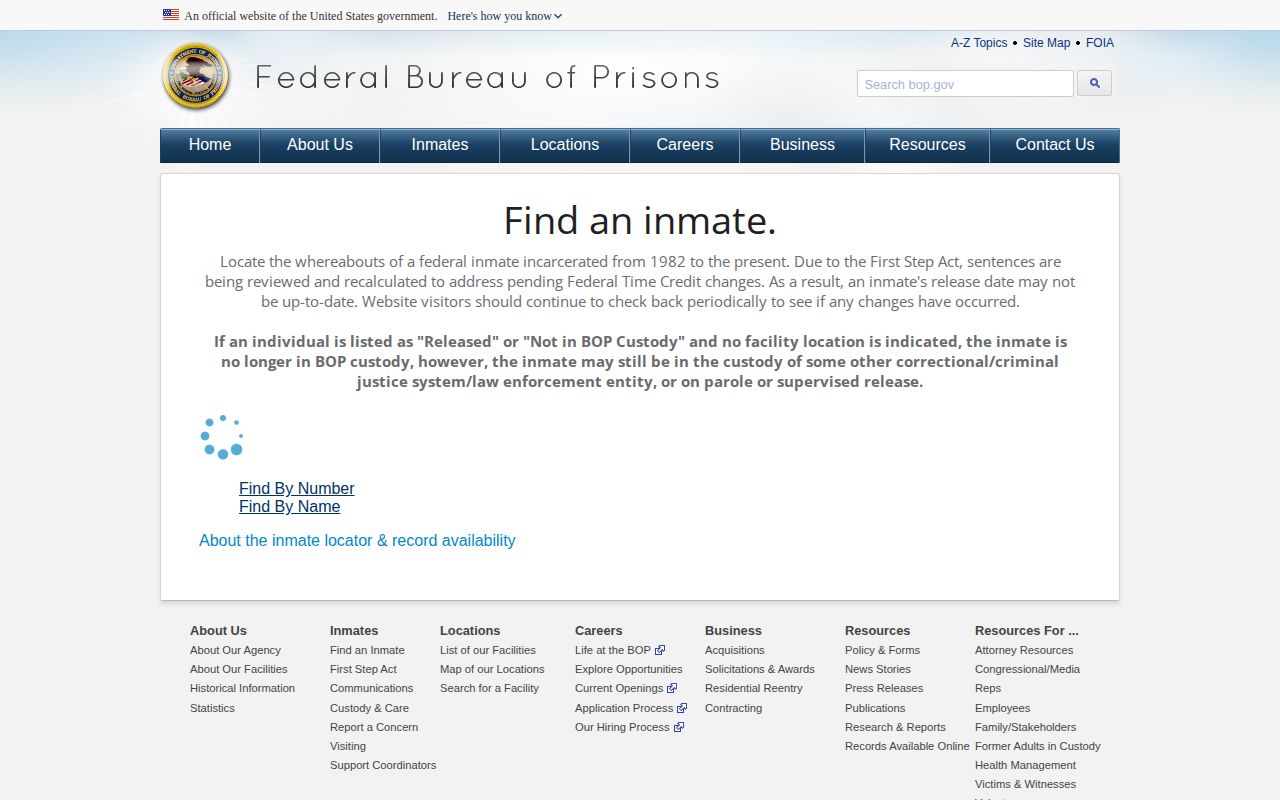
Its number and name routes are useful only after the case has been identified as federal.
Read a BOP Release Result
A locator result must be interpreted as a set. The name and register number establish identity. The location column indicates an institution or a released status. The release date can be past, future, or unknown. None of those fields alone states whether supervision followed, whether another agency took custody, or why a pretrial episode ended.
BOP’s official record explanation describes the meaning and limits of its released records. The captured source below preserves that context.
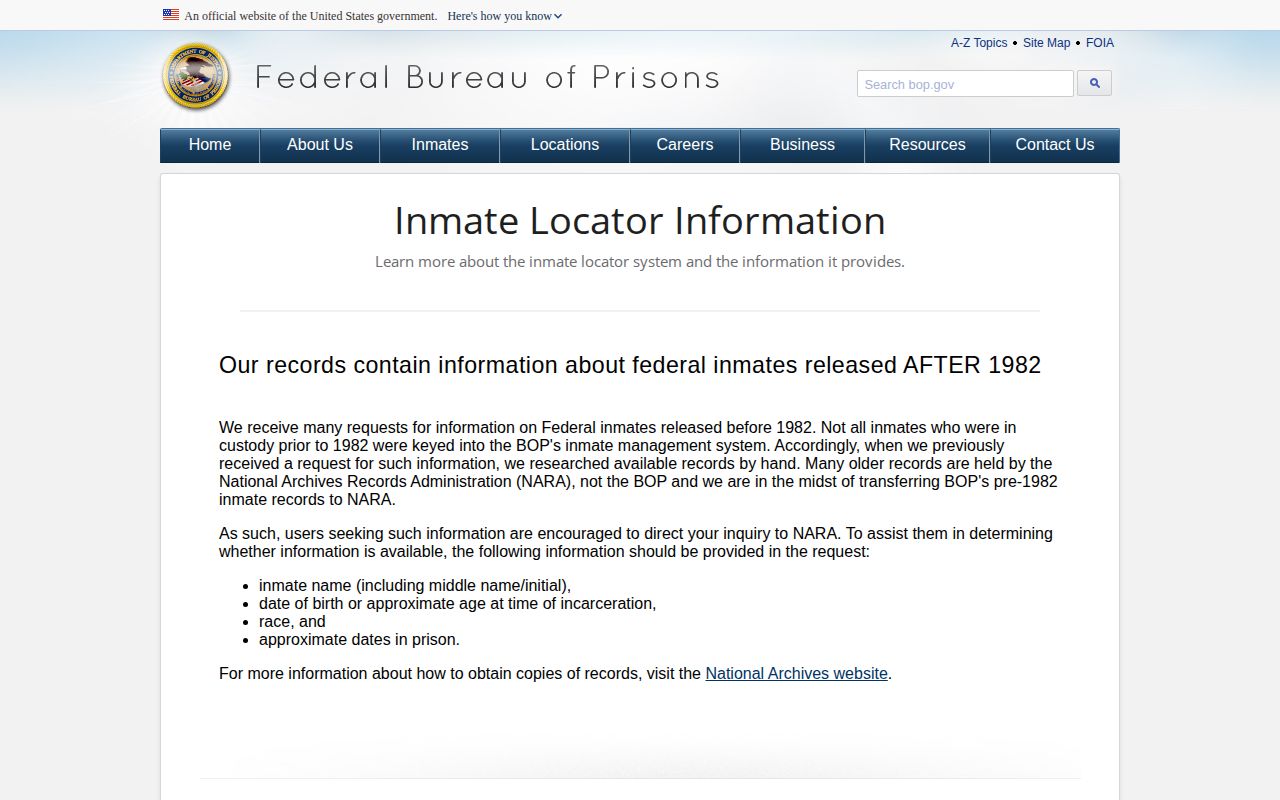
The explanation should remain paired with the live result so a date is not presented as broader proof than BOP intended.
- Past release date
- The recorded endpoint of the BOP custody episode when paired with a released label.
- Future release date
- A projected date that may change before the person leaves.
- Not in BOP Custody
- No current BOP institution, though another authority may follow.
- Unknown
- BOP has not determined the term endpoint shown by the locator.
For a complete release timeline, keep any transfer date separate from a community-release date. Federal supervised release is imposed by the court and monitored outside prison. It is not continued BOP institutional custody, but it means the federal sentence still carries court-ordered conditions.
Braxton Federal Release Court Records
The federal docket explains what the locator cannot. Search PACER using the correct federal district and case identifiers. Obtain the judgment, sentence, detention or release orders, amended judgment, revocation filings, and docket entries that match the BOP register record. A docket disposition can establish legal authority, while BOP supplies the prison-custody date.
No federal prison in Braxton County was identified. A federal defendant could still have a local connection, be held under another arrangement, or later enter a BOP institution elsewhere. The U.S. Marshals Service manages many pretrial movements, but it does not offer a public release-history locator like BOP. Its policy also withholds public prisoner personal histories, photographs, and arrival or departure times.
| Federal question | Productive source |
|---|---|
| Was there a federal case? | PACER docket |
| What sentence or order applied? | Judgment and court filings |
| When did BOP custody end? | BOP Locator or BOP record |
| Did immigration custody follow? | ICE ODLS or ERO |
| Did supervision follow? | Federal judgment and probation records route |
The Braxton County release search helps choose between local, state, federal, and immigration systems before a locator is used.
BOP Release Date Changes
A future BOP date is not fixed. Sentence computation, credit, later court orders, First Step Act recalculations, discipline, and other authorized changes can alter it. Copy the date exactly, label it projected, and note when the result was viewed. The actual released label after the event has a different meaning from a forecast.
When the date appears wrong, begin with the federal judgment and BOP’s administrative records route. Do not recalculate a federal sentence from news reports or from the raw term alone. Credits and custody history can be complex. Ask the source agency for the record that supports the displayed date.
A state jail-credit or good-time rule does not calculate a federal sentence. West Virginia’s WVDCR rules belong to state custody. BOP applies federal law and its own sentence-computation process. A person who moved between systems may therefore have multiple dates, each tied to a different custodian.
Federal Release Versus Transfer
“Released from BOP” names only one custody boundary. A person can move to ICE under immigration authority, to a state custodian on a pending matter, or into federal supervised release in the community. Record the destination when it is public and check the receiving system rather than treating the BOP label as the end of every obligation.
An ICE detainer is a request for notice and a short hold so DHS can assume custody. The BOP release date and the later ICE release date are different events. ODLS may display a person currently detained or released from ICE within its recent window, but it is not a permanent federal history.
Likewise, return to a state facility requires the WVDCR or regional-jail route. A person can be absent from BOP and present in another public locator on the same day. The most accurate wording names each agency, date, and event rather than stating only that the person “was released.”
Older Federal Release Records
BOP’s online coverage begins in 1982. For an older federal prison episode, use the National Archives route described by BOP and identify the person with as much detail as possible. A court docket may also preserve the judgment, but a court sentence date is not automatically the physical release date.
For a recent result that needs documentary proof, preserve the register number and request the appropriate BOP record. Ask for the actual release date and status, not merely the projected field once displayed online. If another agency took custody, seek that agency’s admission and release record as a separate file.
Note: A persistent BOP released result is valuable historical evidence, yet the federal court and receiving custodian still complete the record.
BOP Release Contact and Records
The national locator is the primary public contact point for a BOP release check. Use its official help and records pages for current procedures. No Braxton County office can edit a BOP result. A county sheriff or CRJCF can answer only for records each agency created during its own custody or transport episode.
Federal Bureau of Prisons
National inmate locator
Search by BOP Register, DCDC, FBI, INS number, or name
Coverage: federal records from 1982 to present
Keep the source boundary clear. BOP is productive for federal prison release. PACER is productive for the federal case. ICE is productive for later immigration detention. The Marshals Service has no matching public release-history database. Choosing the correct source prevents a blank local or state result from being mistaken for no federal record.