
Braxton Parole and Probation
Parole and probation can both place a person in the community under rules, yet their legal paths are not the same. Parole is a conditional release from incarceration. The West Virginia Parole Board decides whether an eligible state inmate may be released, while WVDCR Parole Services carries out field supervision. Probation is imposed by a court. It may replace a jail or prison term, follow a short term, or continue after a custody episode. The Braxton County court record is therefore the starting source for probation.
A person on either status is not fully discharged. Discharge means the supervision term has legally ended. Until then, an alleged violation can lead to a court or parole response and, in some cases, a new custody episode. The comparison keeps the two Braxton County supervision routes separate.
| Point | Parole | Probation |
|---|---|---|
| How it starts | Conditional release from state incarceration | Court sentence or court-ordered supervision |
| Decision source | West Virginia Parole Board | Braxton County sentencing court |
| Local verification | WVDCR offender result and Parole Services | Court docket, order, clerk, and probation office |
| End point | WVDCR discharge from parole | Court record showing completion or discharge |
- Parole
- Conditional release from incarceration under WVDCR supervision.
- Probation
- A court-ordered supervision status that may occur without a prison release.
- Discharge
- The legal end of custody and supervision for the sentence at issue.
- Absconder
- A person alleged to have stopped reporting or left supervision without authorization.
Verify Braxton Post-Release Supervision
Start with identity, not a status label alone. The WVDCR prison offender search covers active custody and supervision. A matching result that names parole or a supervising office is strong evidence that a state prisoner left confinement and remains supervised. It is not a complete archive of people whose sentence and supervision have ended. Compare the name, OID, birth information, and other available identifiers before treating the result as the right person.
Probation needs a court check instead. Search the Braxton case through the West Virginia court-record access routes, then obtain the sentencing, probation, modification, revocation, or completion order from the filing clerk. A docket entry may point to the event, but the order supplies its terms. Use these steps for one verified Braxton County supervision record:
- Identify whether the underlying case led to state incarceration, a county court sentence, or both at different times.
- Run the WVDCR DOC search for an active parole or supervision result, matching the person by more than name.
- Search the magistrate or circuit docket and request the actual public order that imposed or changed probation.
- Use the WVDCR district directory for parole, or the Braxton County Probation Office for court probation.
- Ask the correct office how a public status or discharge can be confirmed, then keep its written response with the court record.
Braxton Supervision Uses Two Offices
Braxton County has separate contacts because state parole and judicial probation serve different roles. The Clarksburg Parole Office is the WVDCR Northern District, Region 6 office listed as serving Braxton County. The Braxton County Probation Office is part of the state judiciary. It handles court probation rather than DCR parole. Staff assignments can change, so use the live official pages instead of relying on an old officer name.
Clarksburg Parole Office215 West Main Street
Clarksburg, WV 26301
304-627-2308 Braxton County Probation Office
300 Main Street
Sutton, WV 26601
304-765-2873
Fax: 304-765-2871
The official parole-office page shows which state field office serves Braxton. Its captured view can help confirm that routing before a call.
View the official Clarksburg Parole Office source.
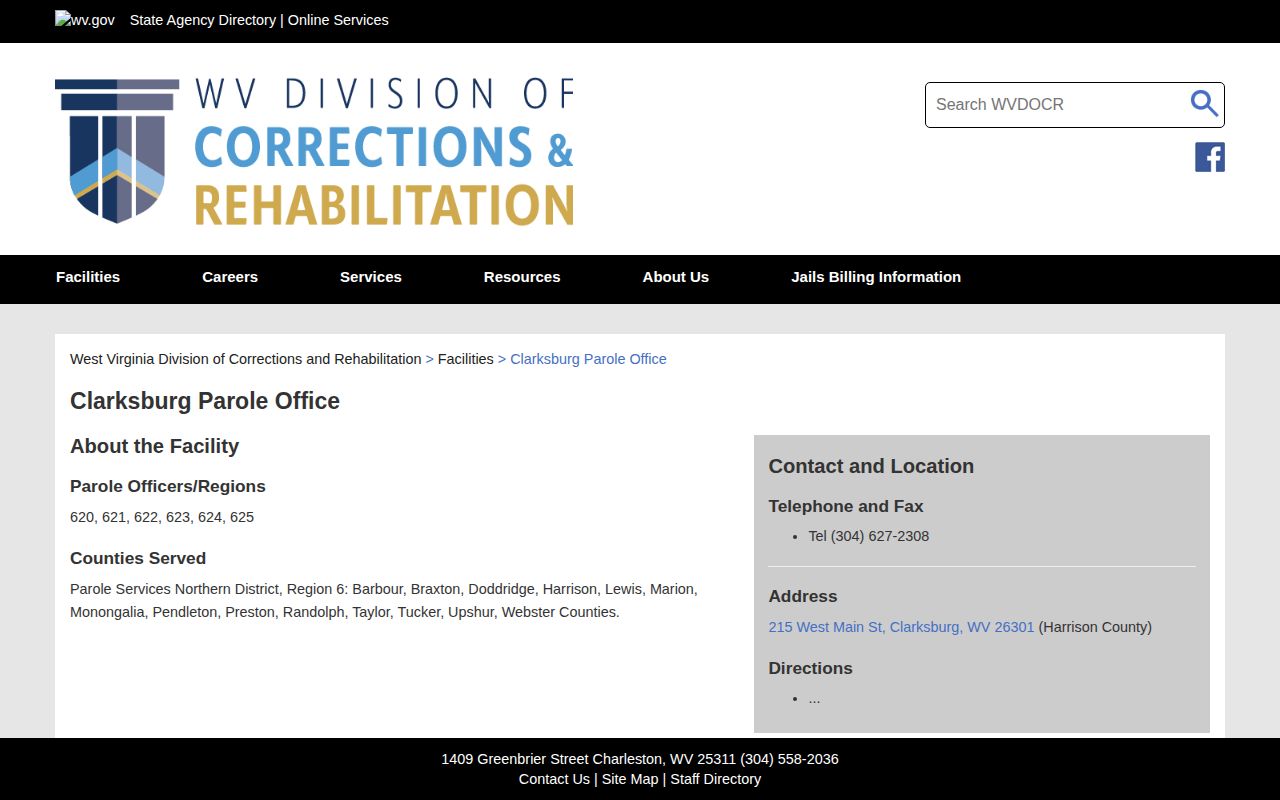
The image belongs to the WVDCR office page, while the probation office remains a separate court contact in Sutton.
Braxton Parole Hearing Records
The West Virginia Parole Board publishes monthly hearing schedules, usually organized by facility or document. No public, name-searchable decisions database was found in the research sweep. Calendar placement means a hearing is scheduled. It does not show that release occurred. The Board describes a denial as continued incarceration with a later review interval, a set-up as another hearing, and a grant as conditional release after stated tasks are met.
A grant may depend on an approved home plan, documents, or other conditions. For a person granted parole while at a regional jail such as Central Regional Jail and Correctional Facility, the Board’s official guidance says transfer to a DCR facility for intake and fingerprints occurs first. It advises anticipating roughly seven to ten days for physical release, but that is general guidance. A hold, transport issue, intake step, or incomplete plan can change the timing. Confirm the actual move with DCR and the custody record.
The captured Board page shows where official release-processing questions are answered.
Open the West Virginia Parole Board guidance.
Use that guidance to interpret a grant, then use WVDCR status and records to confirm the later Braxton County release event.
Note: Eligibility under state law gives a person consideration by the Board, not a right to leave custody on that date.
Braxton Release Resource Guide
WVDCR publishes a facility resource-guide index that includes a Central Regional Jail and Correctional Facility guide. That local document is more useful than a broad list because CRJCF is the regional jail in Braxton County. It can point a released person or family toward identification, health, recovery, transportation, family, and supervision contacts. A PDF can outlive a provider’s phone number or program, so each listed service should be checked before it is used.
The guide does not verify parole or probation. Its role starts after the legal status is known. A person on parole should confirm plans and reporting duties with the Clarksburg office. Someone on probation should use the court order and Sutton probation office. Resource referrals cannot change those terms, and missing a supervision duty is not cured by contacting an unrelated provider.
CRJCF serves eight counties, so the guide may list regional contacts rather than a Braxton-only provider. Check the service area, current intake terms, and direct phone before relying on any entry. Transportation and identity-document help may support a return to the community, but neither proves that DCR or the court approved a plan. The supervising officer remains the source for required reporting, travel, and program instructions.
Braxton Violations and Absconder Status
Conditions vary by order and person, so a generic list cannot establish a violation. Common themes can include reporting, travel limits, treatment, electronic monitoring, and compliance with court or Board directions, but only the actual order and supervising agency control. A probation issue returns to the sentencing court. A parole issue follows WVDCR and Board procedures. Either path may result in a hearing, changed terms, or a return to custody.
No authoritative Braxton-specific public absconder list was located. A missed appointment rumor does not prove that a warrant exists. Check the issuing court or the law-enforcement custodian for a public warrant, and check DCR for parole status. If a person appears again in the regional-jail search, that new custody entry does not erase the fact that an earlier release took place. It marks another episode that must be matched to its own date and legal authority.
Note: An absconder allegation concerns compliance after release; it does not identify the reason for the original Braxton County release.
Braxton Supervision and VINE Notices
West Virginia VINE reports custody changes from participating agencies, and WVDCR has stated that all regional jails are online. It can help confirm that CRJCF reported a release or transfer. VINE does not replace parole or probation records. A release notice identifies a change in the reporting custody episode, not the terms of supervision, the court’s reason, or the lack of another hold.
State law also creates a separate written-notice route. Under W. Va. Code §62-12-23d, the specified written requests go separately to WVDCR and the West Virginia Parole Board because they are distinct agencies. Writing to DCR also enrolls the requester in VINE, but one online registration should not be described as replacing every statutory notice. The relevant office can explain who qualifies and what form is current.
When Braxton Supervision Ends
Supervision ends through a lawful discharge, not merely through time away from jail. For parole, request the WVDCR record that identifies the end of active supervision. For probation, obtain the court entry or order showing completion, discharge, modification, or revocation. Fully discharged state cases may stop appearing in the active DOC search, which is why the agency record and court file matter for an older Braxton County case.
Keep the date and custodian clear. Release from CRJCF, release from state prison, discharge from parole, and discharge from probation are separate events. A court may close probation after the regional-jail episode ended, while WVDCR may keep parole active after prison release. One date should not be copied into all four fields.
Parole eligibility is also distinct from discharge. Under W. Va. Code §62-12-13, the ordinary threshold may be the minimum of an indeterminate term or one fourth of a definite term, but offense rules and other conditions can change it. Section 62-12-13a states the key limit: eligibility permits consideration and does not compel release. The broader Braxton County released-inmate search and record path explains how to pair a supervision result with the actual release record.